
Swing and Slide Gate Repair in Atlanta
Most of our days begin with a gate that will not close or a motor that only hums. We repair swing, slide and walk gates and the automatic operators that move them, from a control board burned out in a storm to a hinge that has let the leaf drop onto the drive.
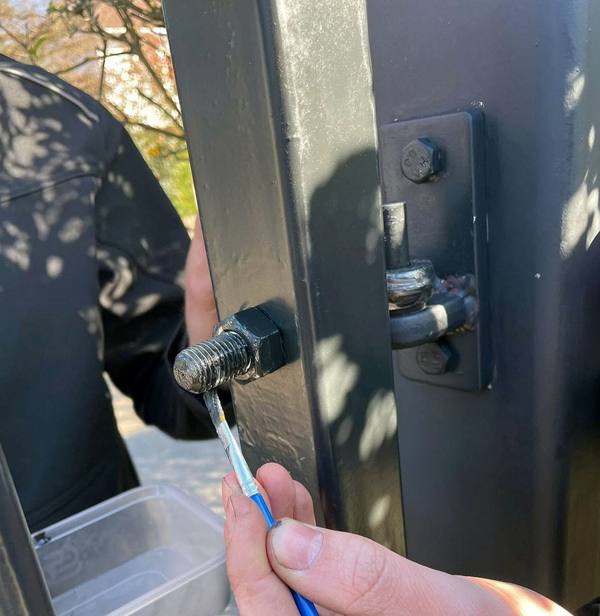
An automatic gate is two machines working as one: the gate, with its posts, hinges or rollers and frame, and the operator, with its motor, gearbox, drive, control board and safety devices. Wear in one shows up in the other. A leaf that has dropped at the latch end drags, the operator works harder on every cycle, and sooner or later a gear strips, a capacitor fails or the board stops the gate because it senses too much resistance.
That is why the order of work on a visit puts the hinges, rollers and post alignment ahead of the operator box: a sagging gate is often the real cause of a fault the opener only shows.
Lightning, Surges and Control Boards
Atlanta gets hard summer thunderstorms, and one lightning strike or power surge can burn out a control board or leave an opener stuck halfway open. The strike does not have to hit the gate: a surge can arrive on the power supply, or on the long low-voltage runs to a keypad, a photo eye or a loop in the drive.

Surge damage is not always complete. A board can lose one input, so the gate opens from a remote but ignores the keypad, or opens and then will not close because it no longer reads its photo eyes. Fuses, the transformer and the accessories can fail with the board or instead of it, so a technician usually tests the supply and each input before condemning the board. When one is replaced, surge protection on the supply and the low-voltage lines is worth discussing.
Symptoms, Likely Causes and When to Stop Using a Gate
Choose the gate and the closest match to what it is doing. The answer gives the likely problem area, whether to stop using the gate until it is checked, and, where one helps, a first check that is safe to make yourself.
Gate Fault Finder
Choose the gate type and what it is doing, then press the button.
Wear Signs and What Each One Points To
Many failures give warning first: a new noise, a slower cycle, a latch that needs a push.
| Sign | Likely Problem Area | What a Visit Looks At |
|---|---|---|
| The leaf has dropped, and the latch needs lifting to close | Worn hinges, loose hinge bolts or a leaning post | Play at each hinge, the post’s plumb, the frame’s square |
| A slide gate rumbles, rocks or rides up on its track | Worn V-groove wheels, a bent track or debris in it | Wheel bearings and grooves, the track’s line, the top guide rollers |
| The chain slaps, sags or jumps its sprocket | A stretched chain, or worn idlers and sprocket teeth | Chain tension and wear, the idler wheels, the end brackets |
| The arm clunks at the start or end of travel | A loose bracket, worn pivot pins or a missing gate stop | Bracket bolts, pins and bushings, the stops and the limits |
| The gate stops or reopens for no visible reason | Photo eyes out of line, an edge sensor fault, or drag | Sensor alignment and wiring, the force setting, any rubbing |
| Rust bubbling at the foot of a post or around a hinge | A post rusting at ground level, or a weakening hinge mount | The post at the ground line, its footing, the hinge welds |
Stalled, Reversing and Derailed Gates
Why does my gate opener hum but the gate does not move?
The motor has power but cannot turn. On many AC operators the start capacitor has failed; on others a stripped gear or a seized arm joint holds it, or the gate itself binds on a dropped hinge or a blocked track.
Stop pressing the remote, since a motor left humming against a load overheats. If the gate has to move, use the operator’s manual release and move it by hand until the cause is found.
Why does my gate reverse before it finishes closing?
The operator believes something is in the way. A photo eye knocked out of line, a lens coated with pollen or a spider web, or low sun shining into a receiver breaks the beam; a torn or waterlogged edge sensor reads as pressed; and a gate that drags can trip the obstruction sensing.
If the gate ever closes on a car or a person without reversing, stop using it in automatic mode until it is repaired.
What does fixing a sagging gate involve?
It depends on what moved. Worn hinge pins or loose hinge bolts are the simple case, put right with new or adjustable hinges. A leaning hinge post has to be brought back to plumb and its footing dealt with, or the sag returns, and a frame racked out of square may need a diagonal brace or welding at the joints. On an automatic gate, the limits and force setting usually need resetting afterward.
Why did my slide gate come off its track?
A wheel worn flat, a track that is bent, loose or packed with debris, or top guide rollers that no longer hold the gate upright; a car striking the gate often starts it. Stop using a slide gate that has left its track or leans away from its guides, and keep people clear, because it can fall. Lifting it back on without fixing the cause usually means it comes off again.
Worn Parts and Sagging Leaves
We replace hinges, rollers, chains and worn-out arms, and most of a gate’s wear lands on exactly those parts. Hinges carry a swing leaf’s whole weight and wear at the pin until it drops; adjustable or bearing hinges let a heavy leaf be set level again. Slide gate wheels flatten, crack or seize, and a cantilever gate’s rollers carry its full weight. Chains stretch until they need replacing, and operator arms wear at their pivots and brackets until they clunk, flex or bend.
A sag is not always the hinge. The post may have shifted in wet clay or the frame racked out of square, and the cure can be a post brought back to plumb, a diagonal brace, re-welded hinge tabs or the leaf rehung level; on a sloped drive, even a small drop at the latch end is enough to drag.

Gate Types We Repair
- Single and double swing gates
- Slide gates running on a V-track
- Cantilever slide gates on roller posts
- Pedestrian gates beside a drive or at an entrance
- Steel, aluminum and wood gates
- The arm, ram and slide operators that drive them
We also handle the keypads, intercoms, card readers and loop detectors that make up a gate’s access control.
Bring the Gate Back Into Service
Call or schedule a visit with the gate type and what it is doing, and the repair can begin at the right end of the problem.