
Seasonal Gate Maintenance in Atlanta
A gate rarely fails all at once. A hinge runs dry, a roller fills with grit, a photo eye clouds over, and the operator works a little harder every cycle until a summer storm or a hot afternoon finds the weak part. We run seasonal maintenance visits to catch those problems before a storm does.
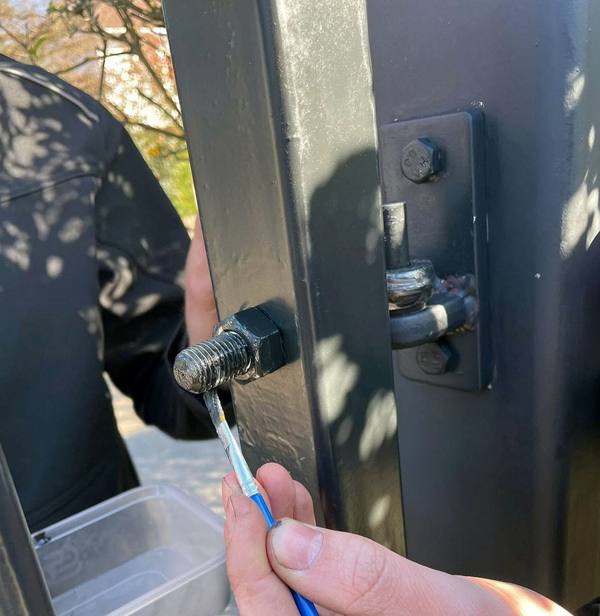
Maintenance is mostly inspection and adjustment. A technician runs the gate through its full travel under power, then by hand with the operator released, listening for a bearing that has started to grind and watching the parts that carry the load: hinges or rollers, posts, the track, and the arm, chain or gear rack that drives the gate.
Small hardware matters as much. The threads of an adjustable hinge bolt, kept coated, still turn when a leaf needs raising or leveling years later; left bare, they rust solid, and a simple adjustment turns into cutting and welding.
Parts a Maintenance Visit Checks and Adjusts
- Hinges and rollers: pins, bushings and bearings checked for wear, greased where they have fittings, and set so each leaf hangs level.
- Tracks: the V-track or guide rail cleared of grit and leaves and checked for dips and loose anchors.
- Opener and limit settings: limits reset where the gate stops short or bumps its stops, and the force setting checked against the gate’s load.
- Safety sensors: photo eyes cleaned, aimed and tested, edge sensors pressed, and the reversing action confirmed.
- Wiring: control box terminals tightened, ant nests and moisture cleared out, and cable runs checked for chafing.
- Hardware: brackets, arm pivots, chain, gear rack, latches and stops tightened or lubricated, and worn parts noted.
Maintenance also shows what is wearing toward failure: a roller with a flat spot, a battery that no longer holds a charge, a post that has begun to lean. Found early, each becomes a planned gate repair on a calm day rather than a gate stuck halfway open in the rain.
How Each Type of Gate Ages
| Gate Type | Parts That Wear | Signs to Watch For |
|---|---|---|
| Swing gate (steel or aluminum) | Hinge pins and bushings, the operator arm’s pivots and brackets, the latch | A leaf that drops at the latch end, a widening gap where the leaves meet, an arm that clunks as it starts |
| Wood swing gate | Hinge bolts in the stile, the frame’s joints, the finish | Sag toward the latch, boards swelling tight in wet weather, gray or split wood where the finish has worn through |
| Slide gate on a V-track | V-wheels and their bearings, the track and its anchors, the chain or gear rack | Grinding, a hop over one spot in the track, a chain that slaps or droops |
| Cantilever slide gate | Carriage rollers on the support posts, the gear rack | A leading end that sags, rubbing on a guide post, an operator that labors more each season |
| Pedestrian (walk) gate | Self-closing hinges or a closer, the latch and strike | A gate that no longer swings shut and latches by itself, a latch that needs lifting |
Seasonal Timing for Atlanta Gates
Spring coats Atlanta in yellow pine pollen. It films over photo eye lenses until the beam weakens, settles into keypads and turns to a gritty paste in slide gate tracks, so the weeks after a season of pine pollen are a sensible time to clean and test. The other is the stretch before the summer storm season, since surge protection, ground connections and the backup battery are better checked in calm weather than after a strike.
Autumn leaves pack into V-tracks and against bottom rails, and the first cold mornings show which batteries were already weak.

Care Between Visits
Between visits, an owner can keep a gate in good order without touching its wiring:
- Keep the track and the swing area clear of leaves, gravel and mulch.
- Trim shrubs and vines back from photo eyes, keypads and the operator housing.
- Wipe photo eye lenses and keypad faces with a soft, damp cloth, without solvents, after heavy pollen.
- Watch and listen to the gate now and then, and note any new noise, drag or hesitation.
Leave the control board and the wiring to a technician, and stop using a gate that reverses into a car, has a leaf off its hinge or shows exposed wiring until it has been checked.
Looking After Tracks, Hinges and Finishes
Should the track or chain on a slide gate be greased?
The chain, yes, lightly and with the lubricant the operator’s maker calls for; a dry chain stretches and wears its sprockets. The track, no. A V-track should be kept clean and dry, because grease holds grit and pollen and turns them into a paste that grinds the wheels. Hinges with grease fittings take grease, while sealed bearings need none.
Should rust on a steel gate be dealt with right away?
Yes, while the spot is small. Rust starts where water sits: the bottom rail, the joints, the hinge welds and the feet of the posts, and a humid summer keeps those places damp. Wire-brush the spot back to sound metal, prime it and paint it. Aluminum does not rust, though the steel hardware fastened to it can.
Does a gate without an opener need maintenance too?
It does, though less of it. Hinges still wear, latches drift out of line and posts can lean as the ground around them shifts. A manual gate that drags, or has to be lifted to latch, has the same problems an operator would strain against, and a wood gate needs its finish renewed before bare wood takes on water and swells.
Why does a gate that ran well last season need adjusting now?
Because the gate has moved, if only a little. A post can shift as the ground around its footing settles or washes out in heavy rain, hinges and rollers wear with every cycle, and wood swells and dries with the weather. Limit settings made for the gate as it hung a season ago can then stop it short or let it bump its stops.
What Maintenance Cannot Fix
Maintenance keeps a sound gate sound. It cannot make an undersized operator strong enough for a heavy gate, pull a leaning post back to plumb, or bring an older gate up to current construction standards. ASTM F2200, the standard for automated vehicular gate construction, calls for openings small enough that a hand or head cannot pass, guarded rollers on slide gates and positive stops, and many older gates were built before it.
When a visit turns up one of these, the choice moves from upkeep to repair, or to a new gate built for its operator and its drive.
A Maintenance Visit Before the Next Storm
Call or send a request with the gate type and anything it has started doing differently, and the visit can be set for a calm stretch of weather.